
10 of 16
Technology
HOPE and the platform underneath it
Meet HOPE
The AI recruiting assistant, built to level the playing field.
A paid advisor’s value is not effort — it is knowing which of a thousand programs will answer, and when to push. HOPE learns that from real outreach behavior across every school that offers a given sport, and gives it away.

Learns as you go
HOPE studies real outreach behavior across the 1,000–1,600 schools that offer a given sport, so families get the same intelligence the wealthy already pay for.
Recommends what's next
As interest patterns emerge, HOPE surfaces matches and next-best actions instead of leaving the athlete guessing.
Tracks every message
Who has been contacted, where momentum is building, delivered as an automated weekly report so nobody has to check manually.
Works for the whole family
Parents and high school coaches share schools, leave notes, and message inside the same app. Everyone stays aligned, not just the athlete.
How it works
From raw program data to a coach replying
- 01
Ingest
Program data across 1,000–1,600 schools per sport: rosters, coaching staff, openings by position, and three years of athlete performance data.
- 02
Score
Power Score rates the athlete from performance history. Coach Grade rates every coach in a program. Both are numbers, not narratives.
- 03
Match
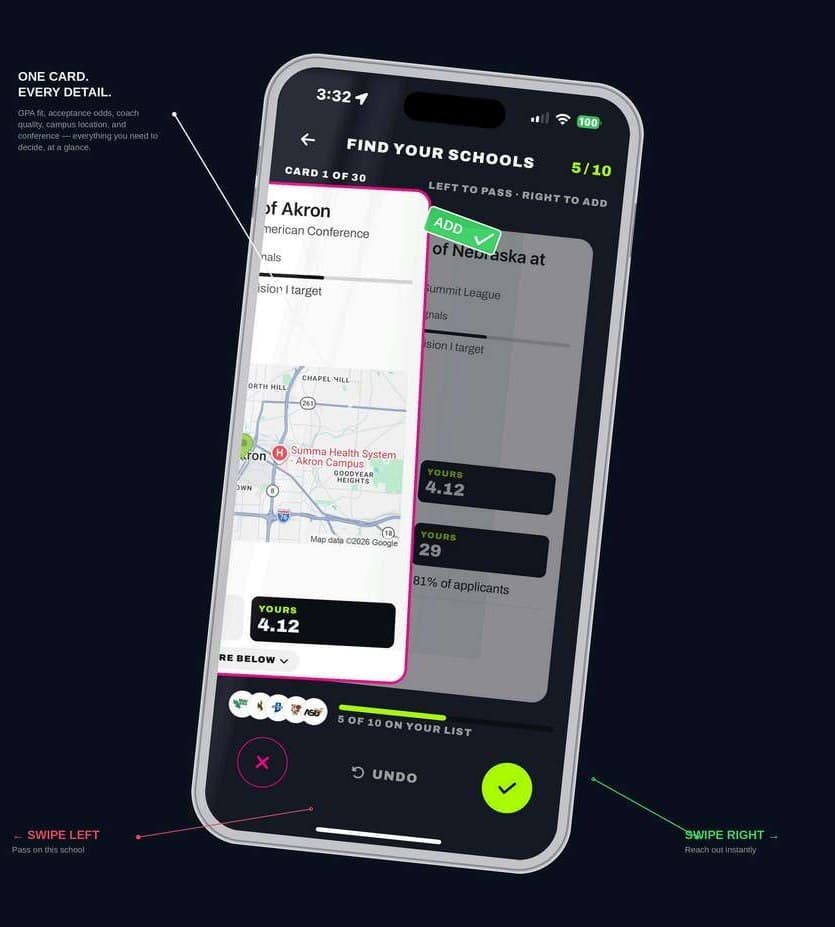
Scores plus stated preferences plus real roster openings produce a ranked school list — and a fit description explaining who thrives there.
- 04
Act
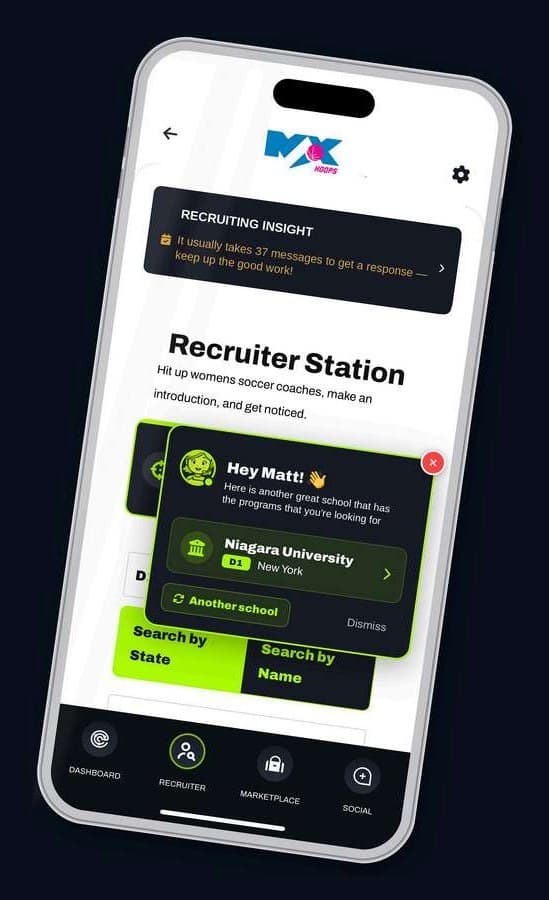
HOPE recommends the next best action, drafts and tracks outreach, and reads the response pattern back into the ranking.
- 05
Report
An automated weekly report to the athlete, the parent, and the high school coach, in one shared account.
Each stage feeds the next. Response data from stage four updates the ranking in stage three, which is why the assistant gets more useful the longer a family uses it.
In the product
What a family actually sees
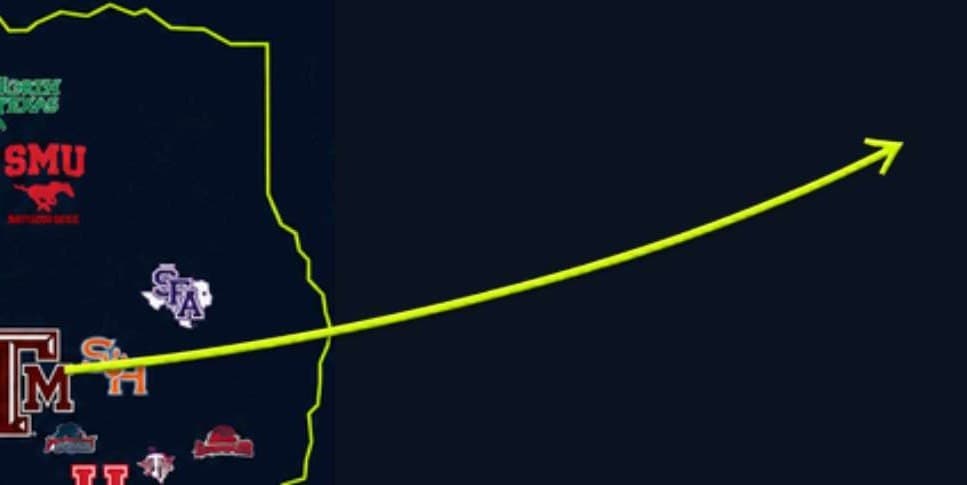
Swipe through matched programs, work the outreach queue, and see the whole country at once. Five minutes from signup to recruitable.
The platform today
Features that empower
All of this is live. App 2.0 shipped, which is why only 4% of the round is earmarked for product.
Power Score
A single rating built from three years of performance data, not a highlight reel.
Coach Grade
Individual performance ratings for every coach in a program, so fit is a fact, not a vibe.
Roster Openings
Real open spots by position, updated per program.
Fit Descriptions
Who thrives at this specific school, written per program.
Map View
Every program in the country, explorable geographically.
Parent & Coach Accounts
Collaborative access so the whole household recruits together.
The outcome funnel
One hundred contacts, ten replies, one offer
A 10% coach reply rate is the number that matters here. Send volume without reply rate is spam; reply rate is evidence the matching works.
Matched
100
programs per athlete
HOPE ranks the athlete against every program that offers their sport and builds a target list sized to the real ratio, rather than the ten schools the family had heard of.
Contacted
100
outbound messages
Drafted, sent, and tracked inside the platform. Every send is an observation: which program, which position, which point in the cycle.
Replied
10
coach conversations
About one in ten messages earns a reply. That reply is the single most valuable event in the system — it is the label the matching model trains against.
Offer
1
scholarship offer
The outcome the whole company is measured on, and the second label: which athlete profile, matched to which program, produced a result.
About one message in ten earns a reply from a college coach.
That reply is not just an outcome — it is the label the model trains against. A directory tells you a program exists. Only observed outreach tells you which programs answer, at which positions, at which point in the cycle.
The proprietary asset, quantified
What a competitor cannot buy
All four figures are platform-measured, not modelled. 150K outbound messages produced 15K coach replies — a 10% reply rate — and those replies produced 1,500 offers, which is the 100:1 contacts-per-offer ratio from the other direction. The three numbers tie.
How the model improves
The loop, and how we measure it
The test of whether the model is learning is not accuracy in the abstract. It is whether contacts needed per offer falls.
Every send is an observation
Program, position, athlete profile, timing in the recruiting cycle, and message content. Nothing about that combination is available to anyone who is not inside the outreach.
What we measure
Contacts logged per month
Every reply is a label
A coach replying is ground truth that this athlete, at this position, was worth this program's time. Supervised learning needs labels, and this is a category where almost nobody has them.
What we measure
Reply rate by sport, position, and division
Every offer closes the loop
The scholarship is the outcome variable. With profile, outreach history, and result, the full training example exists end to end.
What we measure
Offers per 1,000 matched programs, tracked by cohort
Ranking improves, then contacts fall
The test of whether the model is learning is not accuracy in the abstract. It is whether the number of contacts needed per offer goes down over time. 100:1 today is the baseline to beat.
What we measure
Contacts per offer, by cohort — the single metric that proves the loop works
100:1 is today’s baseline. The platform currently observes that a message went out and that a reply came back; capturing the conversation itself is what turns those counters into a training corpus. If the model is genuinely learning from it, that ratio should fall — and a falling ratio is worth more to a strategic acquirer than any amount of headline user growth, because it is the one thing they cannot replicate by licensing a school directory.
Why this is defensible
The data compounds. The pricing doesn’t.
Every message a family sends through the platform teaches the model which programs respond, at which positions, at which point in the cycle. A competitor can copy a school directory in a quarter. They cannot copy nine months of observed coach behavior, and they cannot observe it at all if families are not using their product for free.
Behavioral data, not scraped listings
The asset is what happens after the email is sent.
Free access is the data strategy
More families in the funnel means a sharper model, which makes the free product better, which brings more families.
Collaborative accounts widen the graph
Parents and high school coaches inside the same account contribute signal an athlete-only product never sees.